POV: All AIs Went Offline
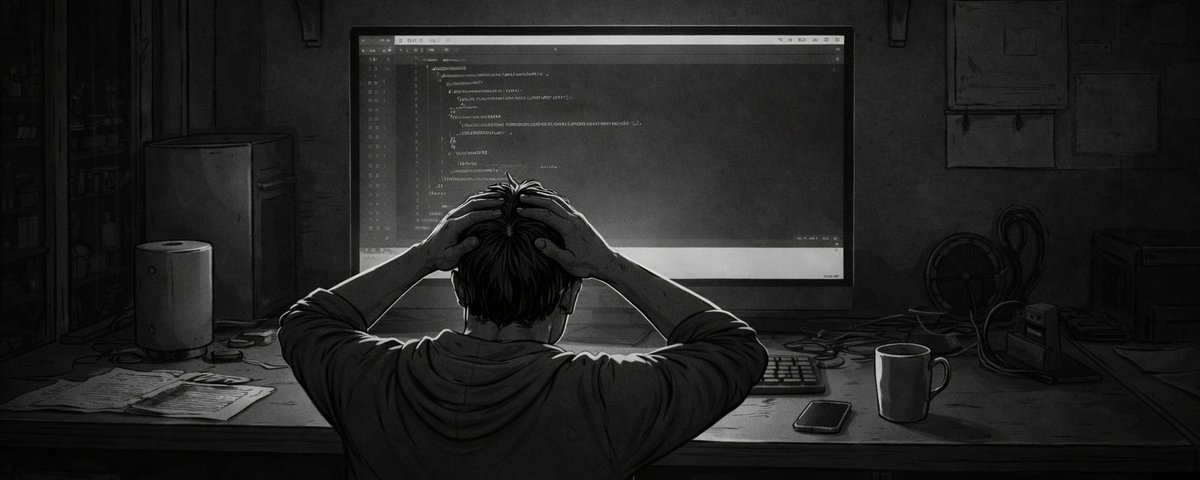
Imagine one morning you're vibe coding your freelance project.
You're in flow. Autocomplete is predicting your next function. The bug you were stuck on is already being explained.
Then suddenly AI stops responding.
You try another platform. Same result.
You refresh. You switch networks. You check Twitter.
Nothing works.
No model is responding.
It began with silence…
After 5 Minutes: The Illusion of Control

ChatGPT, Claude, Gemini, Copilot all down at once.
Not degraded. Not rate-limited. Just gone.
AI coding assistants freeze mid-sentence, leaving half-written logic hanging inside IDEs. Recommendation systems stop refreshing. Smart assistants like Amazon Alexa and Google Assistant go unnervingly quiet. Feeds on X (Twitter) and YouTube feel "off" not broken, just strangely stale, because ranking models have stopped updating in real time.
At this stage, nobody panics.
People assume it's temporary.
A server issue.
A cloud outage.
A bad deploy.
We refresh. We wait.
We still believe we're in control.
After 1 Hour: The Dependency Surfaces
An hour later, the tone changes.
Customer support bots vanish, replaced by long queues and generic automated messages. AI moderation on platforms like YouTube and Instagram slows dramatically. Spam, scams, and low-quality bot content begin slipping through at scale.
Developers feel the hit immediately.
Copilot is gone. Internal AI tools stop functioning. Teams that quietly relied on LLMs for code review, refactoring, debugging help, and documentation suddenly move at half speed.
X (Twitter) explodes with anxiety.
Not because AI is down but because it's down everywhere.
After 1 Day: The Economy Notices
By day one, this is no longer a "tech issue."
AI-driven trading systems are halted or manually overridden. Logistics systems that rely on machine learning predictions slow down. Personalized advertising the backbone of the modern internet economy becomes far less effective.
Search summaries disappear from Google.
Content creation drops sharply.
Freelancers who heavily depended on AI for writing, design, coding, and research feel immediate financial pressure.
A quiet sentence begins circulating online:
"Maybe we depended too much."
After 1 Week: Pain, Then Clarity
A week in, productivity metrics tell a clear story.
Companies slow down significantly. AI-generated content farms collapse. Startups built purely as thin layers on top of AI APIs shut down almost overnight. Universities revert to manual grading and oral evaluations.
But something unexpected happens.
Developers sharpen again.
Manual coding returns. Debugging becomes thoughtful instead of reactive. Human-written content improves in originality and voice. Fundamentals (data structures, system design, core logic) suddenly matter far more than prompt engineering.
For developers especially, this week feels personal.
Your real skills are visible again.
There is no autocomplete to hide behind.
After 1 Month: The Bubble Bursts
After a month, the financial reset becomes unavoidable.
Major AI companies lose billions in valuation. Demand for AI hardware drops sharply. AI SaaS startups quietly disappear from pitch decks and job listings.
Entire industries marketing, design, customer support slow down noticeably.
But core software engineering survives.
Real builders rise.
Open-source contributions increase as developers collaborate more and rely less on external intelligence layers. The industry sheds hype and keeps substance.
The question investors now ask is simple:
"What exists without AI?"
Only the strongest products survive that test.
After 6 Months: Human-Centered Systems
Six months later, society adapts.
Workflows are redesigned around human capability instead of automation-first assumptions. Companies hire more engineers instead of buying AI subscriptions. Universities redesign assignments to test reasoning, not output.
Fake and mass-generated content drops drastically.
People internalize a powerful truth: AI was an amplifier not the foundation.
After 1 Year: A Slower, Stronger Tech Culture
One year later, the tech industry feels different.
Slower.
More deliberate.
Less noisy.
Automation research continues, but with more caution and structural safeguards. Humans become more valuable again not because machines failed, but because blind dependence did.
Coding culture shifts toward craftsmanship. Engineers are evaluated on clarity, architecture, problem-solving ability, and judgment not how effectively they talk to a model.
You can read more of my blogs at x.com/akramcodez/articles or on medium.com/@akramcodez
discuss on x ↗